

How US financial markets react to geopolitical shocks hitting oil supply
Prepared by Massimo Ferrari Minesso, Bruno Lopes Mendes, Arthur Stalla-Bourdillon and Viktória Vidaházy
Published as part of the ECB Economic Bulletin, Issue 4/2026.
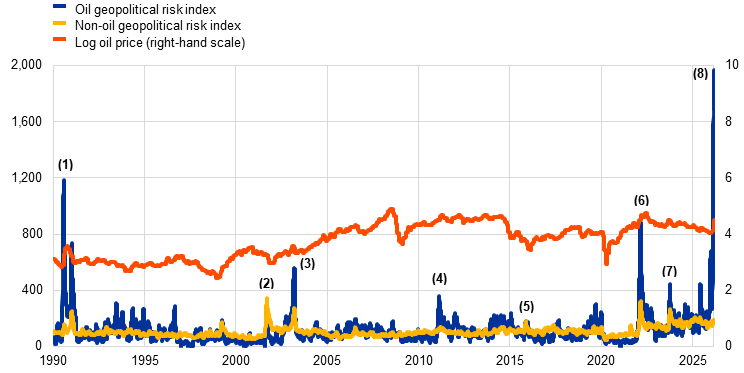
Recent geopolitical shocks have disrupted global energy markets. The two largest geopolitical shocks in recent years – Russia’s invasion of Ukraine and the current war in the Middle East – triggered sharp energy price spikes in the two weeks following the start of the conflict, with oil prices rising by about 30% and 50% respectively (Chart A). While geopolitical shocks typically weigh on economic growth (Caldara and Iacoviello, 2022), their inflationary effects are less clear (Ferrari Minesso et al., 2023; Brignone et al., 2024).[1] However, shocks involving global energy supply disruptions, such as the closure of the Strait of Hormuz, drive oil prices up. This fuels inflation, likely amplifying the contractionary effect on growth and affecting the reactions of financial markets. Focusing on the United States, this box examines these reactions using a new measure of oil-related geopolitical shocks from Iacoviello and Tong (2026).
Chart A
Geopolitical risk and oil prices
(left-hand scale: index; right-hand scale: log of US dollars per barrel)
Sources: Iacoviello and Tong (2026), Haver Analytics and ECB staff calculations.
Notes: The numbered peaks refer to the following geopolitical events: (1) Gulf War, (2) 9/11 terrorist attacks, (3) invasion of Iraq, (4) Arab Spring and civil war in Libya, (5) Paris terrorist attacks, (6) Russia’s invasion of Ukraine, (7) Israel-Hamas war, (8) current war in the Middle East. The latest observations are for March 2026.
A new index developed with the help of artificial intelligence (AI) identifies geopolitical events linked to global energy markets. Iacoviello and Tong (2026) use AI to analyse over five million US newspaper articles, refining the keyword-based approach used by Caldara and Iacoviello (2022) to measure geopolitical risks. Their method identifies geopolitical events affecting energy supply (e.g. the Gulf War or the current war in the Middle East), distinguishing them from those without direct energy-market disruptions (e.g. the 2015 Paris terrorist attacks). The current war in the Middle East has caused a sharp spike in the oil geopolitical risk index, which clearly stands out in a historical perspective. By identifying specific events disrupting energy supply, the new index improves on existing frameworks linking geopolitical events and the oil market.[2][3] As in Iacoviello and Tong (2026), we focus on days when the index is two standard deviations above its average. The monthly sums of changes in oil prices on those days are used as instruments for oil-related geopolitical shocks in a Bayesian vector autoregression (BVAR) model of US financial markets, augmented with key macroeconomic indicators.
Chart B
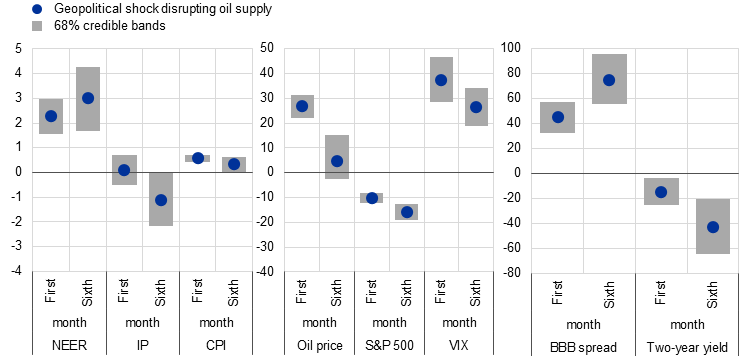
Response of US variables to geopolitical shocks disrupting oil supply
(left-hand and middle panels: percentages; right-hand panel: basis points)
Sources: Iacoviello and Tong (2026), Haver Analytics and ECB staff calculations.
Notes: The chart shows the responses of the variables shown to a geopolitical shock disrupting oil supply, scaled to a 10% fall in the S&P 500 index on impact. The BVAR model includes: the oil geopolitical risk index (Iacoviello and Tong, 2026), the Brent crude oil price, the two-year US bond yield, the S&P 500, the nominal effective exchange rate of the US dollar (NEER), the VIX index of expected volatility, the US BBB corporate bond spread, US industrial production (IP) and the US consumer price index (CPI). All variables other than the yield and spread enter the model in monthly log levels. To identify shocks, the index is instrumented by summing, for each month, the changes in the oil price on days when the index is two standard deviations above its mean (Iacoviello and Tong, 2026). The model is estimated from February 1990 to February 2026.
Geopolitical shocks that disrupt oil supply reduce economic activity, increase prices and are associated with higher risk premia. Following an oil-related geopolitical shock, calibrated to a 10% fall in US stock prices in the first month, oil prices rise by around 30% and remain above pre-shock levels for around two quarters (Chart B). The increase in oil prices feeds through to US consumer prices, although the effect is modest, while industrial production contracts with a lag (falling by up to 1% after six months). By contrast, the impact on financial markets is stronger. Stock prices remain about 20% below their pre-shock level after two quarters. The dollar appreciates continuously, reflecting both higher oil prices and safe-haven dynamics.[4] There are increases in risk indicators, such as the VIX index of expected volatility and corporate bond spreads. Risk-free rates decline, reflecting either safe-haven considerations or expectations that monetary policy will be loosened as output declines more persistently than inflation increases.
Chart C
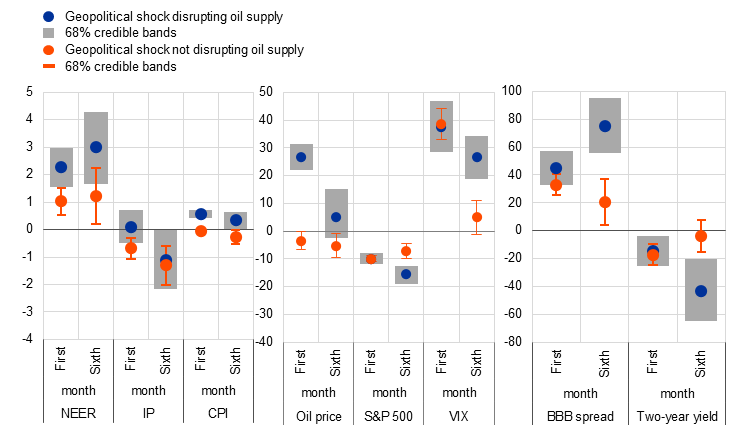
Comparison of geopolitical shocks disrupting and not disrupting oil supply
(left-hand and middle panels: percentages; right-hand panel: basis points)
Sources: Iacoviello and Tong (2026), Haver Analytics and ECB staff calculations.
Notes: The chart shows the responses of the variables shown to a geopolitical shock disrupting oil supply (blue) versus responses to shocks that do not affect oil supply (red), both scaled to a 10% fall in the S&P 500 index, estimated with the same BVAR model. Geopolitical shocks that are independent of oil supply are identified using the non-oil geopolitical risk index of Iacoviello and Tong (2026) instrumented by changes in the gold price (Georgiadis et al., 2024; Piffer and Podstawski, 2018).
Oil price dynamics are a key amplifying channel for the effects of geopolitical shocks. Financial market reactions to geopolitical events are much milder when shocks do not affect global oil supply than when they do (Chart C). Oil prices fall slightly instead of increasing, as higher geopolitical risk weighs on industrial production and aggregate demand, reducing the demand for oil. This supports the economic recovery, as lower oil prices translate into higher real incomes for households and lower production costs and inflation, cushioning the blow to activity. As a result, the decline in stock prices is less pronounced over time. While US yields decrease, the fall fully reverses after six months. The dollar appreciates less without support from higher oil prices, which generally strengthen it, as the United States has been a net primary energy exporter since 2019 and a large share of oil trade is invoiced in dollars (Ricci, 2024). Although risk metrics increase temporarily, they also recede after two quarters. On the real economy side, industrial production recovers faster after six months, and consumer prices fall in the medium term instead of increasing. These results show how oil prices amplify geopolitical shocks, putting upward pressure on inflation in particular.
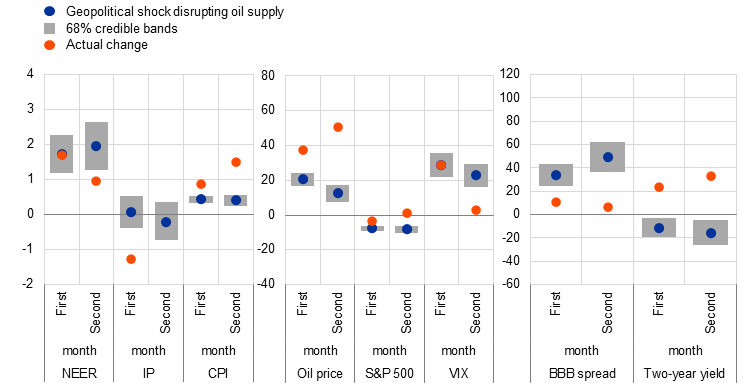
Market reactions to the war in the Middle East have been contained relative to historical patterns. Chart D compares the market reactions to the conflict with model-implied elasticities.[5] The associated shock has indeed been substantial. Around 20 million barrels of oil normally pass through the Strait of Hormuz every single day and, although some mitigating factors have been at play (e.g. redirection of flows through pipeline networks), the net supply loss has amounted to 10-15 million barrels per day (10-15% of global supply). Oil prices temporarily rose to nearly USD 120 per barrel, exceeding what historical patterns would predict for an oil-related geopolitical shock of this size. By contrast, the reaction of other financial variables has been muted. Stock prices fell but started to rise again after about one month, while the dollar appreciated in March but by April had returned to almost the same level as at the start of the year. Risk spreads widened slightly at the start of the conflict, to about half the levels suggested by historical patterns, before returning to pre-war levels. Risk-free rates increased instead of falling, possibly reflecting concerns about inflation following a shock of that size. Strong underlying US macroeconomic fundamentals, oil exports from the United States and strong investment in AI-related stocks may help explain the overall benign response. But the limited repricing remains striking given the scale of the oil shock. Markets may be treating the disruption as temporary, and therefore as not warranting continued high risk repricing. If the conflict persists or monetary policy reacts more aggressively than expected, this may expose financial assets to sudden repricing and potentially rapid sell-offs.
Chart D
Current pricing of geopolitical risk
(left-hand and middle panels: percentages; right-hand panel: basis points)
Sources: Iacoviello and Tong (2026), Haver Analytics and ECB staff calculations.
Notes: The chart shows the responses of the variables shown to a model-implied geopolitical shock disrupting oil supply (blue), scaled to match the VIX reaction at the start of the war in the Middle East in February 2026. Actual changes (red) are the changes in the financial variables between February and March 2026 (first month) and February and April 2026 (second month). For IP and CPI, the latest observations are for March 2026.
References
Brignone, D., Gambetti, L. and Ricci, M. (2025), “Geopolitical risk shocks: when size matters”, Working Paper Series, No 2972, ECB, May (revised).
Caldara, D. and Iacoviello, M. (2022), “Measuring geopolitical risk”, American Economic Review, Vol. 112, No 4, April, pp. 1194-1225.
Ferrari Minesso, M., Lappe, M.-S. and Rößler, D. (2023), “Geopolitical risk and oil prices”, Economic Bulletin, Issue 8, ECB.
Georgiadis, G., Müller, G.J. and Schumann, B. (2024), “Global risk and the dollar”, Journal of Monetary Economics, Vol. 144, 103549.
Iacoviello, M. and Tong, J. (2026), “The AI-GPR Index: Measuring Geopolitical Risk using Artificial Intelligence”, Working Paper, Federal Reserve Board of Governors.
Kilian, L., Plante, M.D. and Richter, A.W. (2024), “Geopolitical Oil Price Risk and Economic Fluctuations”, Working Paper, No 2403, Federal Reserve Bank of Dallas, May.
Piffer, M. and Podstawski, M. (2018), “Identifying Uncertainty Shocks Using the Price of Gold”, The Economic Journal, Vol. 128, No 616, pp. 3266-3284.
Pinchetti, M. (2025), “Geopolitical Risk and Inflation: The Role of Energy Markets”, Working Paper, No 1005, Banque de France.
Ricci, M. (2024), “The link between oil prices and the US dollar: evidence and economic implications”, Economic Bulletin, Issue 7, ECB.
Verduzco-Bustos, G. and Zanetti, F. (2026), “The Effects of Geopolitical Oil Price Shocks”, CESifo Working Papers, 12606, April.
Legal Disclaimer:
EIN Presswire provides this news content "as is" without warranty of any kind. We do not accept any responsibility or liability for the accuracy, content, images, videos, licenses, completeness, legality, or reliability of the information contained in this article. If you have any complaints or copyright issues related to this article, kindly contact the author above.
